
Does zero contact work? What the research suggests
Does zero contact work? If by “work” you mean helping you feel better and move on, there are good reasons to think so. If you mean guaranteeing an ex comes back, no, and no honest guide should promise that. Here's what the research actually suggests.
First, what does “work” mean?
People ask this question with two different goals in mind: healing, or getting back together. Zero contact is a strong tool for the first. For the second, nobody can promise an outcome, because it depends on another person's choices. This article is about healing.
Heartbreak behaves like craving
In an fMRI study, people who had recently been rejected by a partner they still loved looked at that person's photo. Their brains showed activity in regions linked to reward, motivation and craving, systems also involved in addiction (Fisher et al., 2010).
If longing for an ex works partly like craving, then contact works like a small dose: relief for a moment, and the craving stays alive. Zero contact is the equivalent of not keeping the temptation in the house.
Rejection really hurts
A study published in PNAS found that when people who had been through an unwanted breakup looked at a photo of their ex and thought about the rejection, brain regions that also process physical pain became active (Kross et al., 2011). Each message, photo or profile visit exposes you to that sting again.
Checking their profile is linked to slower recovery
A study of Facebook use after breakups found that people who kept monitoring their ex's page reported more distress, more negative feelings and more longing for the ex, and less personal growth (Marshall, 2012). It shows an association, not proof of cause, but it matches what many people feel: looking keeps the wound open.
Making sense of it helps too
In one study, people who repeatedly reflected on their breakup in structured sessions developed a clearer sense of who they were without their ex and reported less emotional distress (Larson & Sbarra, 2015). Zero contact gives you the quiet for that reflection, through journaling, short lessons or conversations with friends.
When zero contact works best
- When it's consistent. Occasional contact restarts the pull.
- When it's paired with something: routines, people, writing, sleep.
- When the goal is your recovery, not a reaction from them.
- When you plan for urges instead of relying on willpower in the moment.
When it isn't enough
Zero contact is not a treatment for depression, anxiety or trauma. If heartbreak has been affecting your sleep, work or safety for weeks, or you're having thoughts of harming yourself, please talk to a professional or a helpline. If you're leaving an abusive relationship, zero contact can be part of a safety plan, and a domestic violence service can help you do it safely.
So, does zero contact work?
For healing, the evidence points the same way: less exposure to the person, less checking, more reflection and more time on your own life are all linked to better recovery. Zero contact is a practical way to get all four. Start with zero contact explained, then follow the step-by-step guide to zero contact after a breakup.
Frequently asked questions
Does zero contact make an ex come back?
Sometimes exes reach out during no contact and sometimes they don't. No method can control another person. Zero contact is most useful as a way to recover, whatever they do.
How long until zero contact starts working?
Many people find the first week the hardest and notice urges coming less often after a few weeks. It varies with the relationship and with how strictly contact is avoided.
Does zero contact work if we have children together?
Full zero contact may not be possible, but low contact works on the same principle: keep communication brief, written and only about logistics, and stop checking their social media.

From the research to your own streak
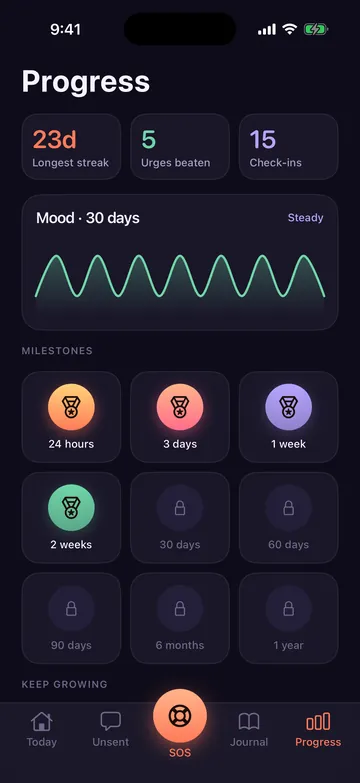
Zero Contact is built around what helps: less contact, less checking, more reflection. Track your streak, ride out urges with SOS and lock tempting apps with Emergency Mode.

Sources
- Fisher, H. E., Brown, L. L., Aron, A., Strong, G., & Mashek, D. (2010). Reward, addiction, and emotion regulation systems associated with rejection in love. Journal of Neurophysiology, 104(1), 51–60. doi.org/10.1152/jn.00784.2009
- Kross, E., Berman, M. G., Mischel, W., Smith, E. E., & Wager, T. D. (2011). Social rejection shares somatosensory representations with physical pain. PNAS, 108(15), 6270–6275. doi.org/10.1073/pnas.1102693108
- Marshall, T. C. (2012). Facebook surveillance of former romantic partners: Associations with postbreakup recovery and personal growth. Cyberpsychology, Behavior, and Social Networking, 15(10), 521–526. doi.org/10.1089/cyber.2012.0125
- Larson, G. M., & Sbarra, D. A. (2015). Participating in research on romantic breakups promotes emotional recovery via changes in self-concept clarity. Social Psychological and Personality Science, 6(4), 399–406. doi.org/10.1177/1948550614563085
Zero Contact is a self-help tool, not therapy or medical care. If you are in danger or thinking about hurting yourself, contact your local emergency number or find a helpline at findahelpline.com.