
Zero contact after a breakup: a step-by-step guide
Deciding on zero contact after a breakup is the easy part. Keeping it at 1 a.m. on day nine is the hard part. This guide walks through the first day, the first week and the first month, with practical moves for the moments you'll want to break it.
Before you start: write your rule
Write one clear rule, so you're not renegotiating it every evening. For most people it's: “No messages, calls, likes or profile checks for 30 days, then I'll decide again.” If you share children or work together, write the low contact version: “Only logistics, only in writing, only short.”
The first 24 hours
The first day is the loudest. Expect a wave of “just one message” thoughts. That's normal. It's withdrawal, not a sign you made the wrong choice.
- Mute or archive the chat. You don't have to block, but take them off your home screen.
- Move their photos to a hidden album. Deleting can wait.
- Tell one person you trust what you're doing, so you're not carrying it alone.
- Go to bed earlier than usual. Tired minds negotiate badly.
The first week
Days two to seven are about routines. Urges come in waves, often at predictable times: on the way home, after dinner, late at night, after a drink or a sad song.
- Notice your risky hours and plan something for them.
- Rearrange your phone so the apps you'd use to reach them aren't on the first screen.
- Eat, move and sleep as if you were getting over the flu, because your body is under real stress.
When the urge hits: the 10-minute rule
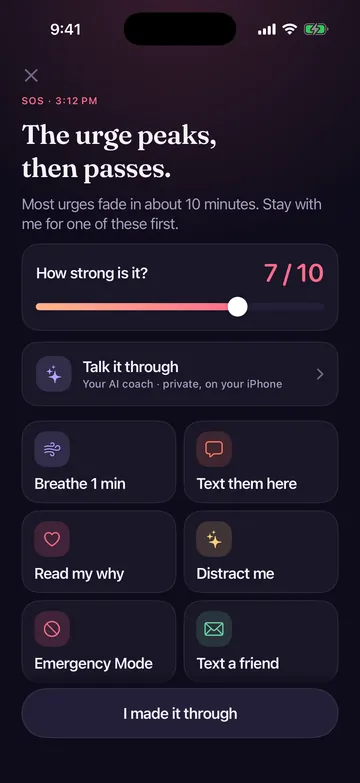
An urge feels permanent, but it isn't. Cravings tend to rise, peak and pass if you don't act on them. Addiction researchers call riding it out “urge surfing”, and a brief urge-surfing instruction helped smokers cut down in a study by Bowen and Marlatt (2009). The same idea works for the pull to text an ex: give it ten minutes before you decide anything.
- Rate it. How strong is it, from 1 to 10? Naming the number creates a little distance.
- Breathe for one minute. Make the exhale longer than the inhale.
- Write the message somewhere it can't send. Say everything.
- Read your why. The reasons you chose this, in your own words.
- Distract yourself or reach out. Walk, shower, or text a friend instead.
Weeks two to four: the quiet middle
Somewhere in the second or third week, urges usually come less often but can still surprise you: a song, an anniversary, a mutual friend's post. This is where many people slip, because they feel “better enough” to check.
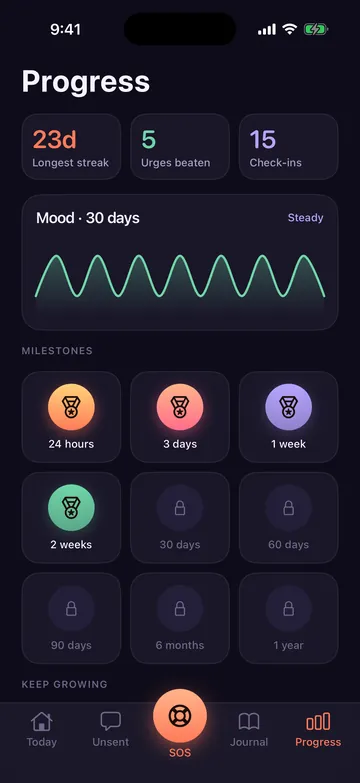
- Keep counting your days. Progress you can see is easier to protect.
- Journal for five minutes in the evening. Writing about emotional experiences has been linked to better wellbeing (Pennebaker, 1997).
- Stop checking their profiles. Monitoring an ex on Facebook was linked to more distress and longing, and less personal growth (Marshall, 2012).
If you break zero contact
It happens. A slip is a moment, not a verdict. Don't spiral into “I've ruined everything”. Note what triggered it, restart your count and go back to the plan. Your longest streak still happened.
After 30 days
At the one-month mark, read back through your journal. Most people notice they think about their ex less often and with less urgency. Decide whether to extend to 60 or 90 days. To understand why it gets easier, read does zero contact work, or see how the Zero Contact app works.
Frequently asked questions
How long does it take to stop wanting to text an ex?
It varies a lot. Many people notice urges getting weaker within a few weeks of real no contact, especially if they stop checking the ex's profiles. Each contact tends to restart the pull, so consistency matters more than willpower.
Should I tell my ex I'm doing no contact?
You don't have to. If you live together, share children or have practical matters to sort out, a short neutral message is enough: you need space and will only reply about logistics.
Should I block my ex?
Blocking is fine if seeing them hurts or they keep reaching out. For many people, muting is enough. Choose whatever makes contact harder in your weakest moments.

From your first day to your thirtieth
Zero Contact keeps you company through every step of this guide: a live streak, an SOS for every urge, a private AI coach that never helps you text them, and a day-by-day plan.

Sources
- Bowen, S., & Marlatt, A. (2009). Surfing the urge: Brief mindfulness-based intervention for college student smokers. Psychology of Addictive Behaviors, 23(4), 666–671. doi.org/10.1037/a0017127
- Pennebaker, J. W. (1997). Writing about emotional experiences as a therapeutic process. Psychological Science, 8(3), 162–166. doi.org/10.1111/j.1467-9280.1997.tb00403.x
- Marshall, T. C. (2012). Facebook surveillance of former romantic partners: Associations with postbreakup recovery and personal growth. Cyberpsychology, Behavior, and Social Networking, 15(10), 521–526. doi.org/10.1089/cyber.2012.0125
Zero Contact is a self-help tool, not therapy or medical care. If you are in danger or thinking about hurting yourself, contact your local emergency number or find a helpline at findahelpline.com.