
Zero contact explained: what the no contact rule really is
Zero contact means choosing, for a set time or for good, not to call, text, message, follow or check on an ex after a breakup. It sounds simple. In practice it is one of the hardest and most useful things you can do for yourself, and this guide explains why, what counts, and how to start.
What zero contact means
Zero contact (also called no contact, or the no contact rule) is a boundary you set with yourself, not a game you play with them. You stop all direct and indirect contact: no messages, no calls, no likes, no “happy birthday”, no watching their stories from a second account, no asking friends what they're up to.
It is different from playing hard to get. The goal is not to make them miss you. The goal is to give your own mind enough quiet to recover.
Why zero contact helps after a breakup
Heartbreak isn't only sadness. Brain-imaging research on people recently rejected in love found activity in regions linked to reward and craving, the same systems involved in addiction (Fisher et al., 2010). Another study found that looking at a photo of an ex after an unwanted breakup activated areas that also process physical pain (Kross et al., 2011).
That's why one “harmless” message can undo a good week: every contact is a small hit that restarts the craving. Zero contact removes the hits, so the pull can finally fade.
- Your brain gets space to stop expecting them.
- You stop reading every reply, or every silence, as a verdict on your worth.
- You get your attention back for sleep, friends and work.
- You can see the relationship clearly instead of through hope.
What counts as contact
More than most people think. Contact is anything that keeps them at the centre of your day:
- Texts, calls, voice notes, emails and DMs, including “just checking you're OK”.
- Liking, reacting to or replying to their posts and stories.
- Checking their profiles, online status or location.
- Asking mutual friends about them, or sending messages through friends.
- Rereading old chats or scrolling old photos for hours.
- Turning up where you know they'll be.
If you share children, a home or a job, total zero contact may not be possible. That's what low contact is for: polite, brief, logistics only. We cover it in our guide to zero contact with an ex.
How long should zero contact last?
A common starting point is 30 days, because the first weeks are when urges are strongest. Many people continue to 60 or 90 days, and some decide never to restart contact at all. A better question than “how long?” is “what do I need to feel steady without them?”. Set a minimum, and give yourself permission to extend it.
How to start zero contact today
- Write down your why. One or two sentences you'll read when you want to text: what happened, and why you chose distance.
- Mute, don't announce. You don't owe anyone a dramatic goodbye. Mute or archive the chat and their profiles so they stop appearing.
- Plan for the hard hours. Late nights, weekends and after a drink are classic. Decide now what you'll do instead.
- Have an urge plan. When the pull hits, give it ten minutes: breathe, write the message somewhere it can't send, or call a friend.
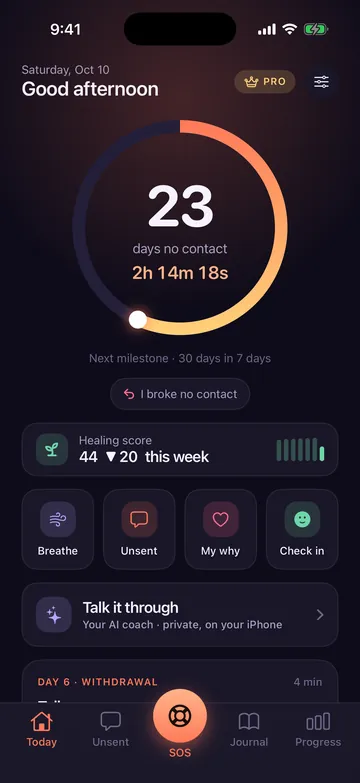
- Count the days. Seeing your streak grow makes each day feel like something you built, not just something you survived.
The full version, day by day, is in our step-by-step guide to zero contact after a breakup.
Zero contact isn't a punishment
Zero contact is sometimes sold as a tactic to “win” a breakup or get an ex back. We don't see it that way. People heal when their attention returns to their own life, not when it stays fixed on someone else's reaction. If they reach out while you're in no contact, you get to choose, calmly, what you want. That choice is the point.
No contact isn't about them. It's about letting your mind stop waiting.
Frequently asked questions
Is zero contact the same as no contact?
Yes. Zero contact, no contact and the no contact rule all describe the same idea: no direct or indirect contact with an ex for a period of time. We explain the naming in contact zero or zero contact.
Is zero contact manipulative?
It doesn't have to be. Used to heal rather than to provoke a reaction, it is simply a boundary. You don't need to announce it, and you can still deal with genuine emergencies or children's logistics.
What if my ex contacts me first?
You decide, calmly. You can take time before answering, keep it short, or not reply at all. A message from them doesn't reset your progress. Only your own choices do.

From reading about zero contact to doing it
Zero Contact turns the no contact rule into something you can keep: a live streak, a 10-minute SOS for urges, a private AI coach and a 90-day plan. Free to start, no account.

Sources
- Fisher, H. E., Brown, L. L., Aron, A., Strong, G., & Mashek, D. (2010). Reward, addiction, and emotion regulation systems associated with rejection in love. Journal of Neurophysiology, 104(1), 51–60. doi.org/10.1152/jn.00784.2009
- Kross, E., Berman, M. G., Mischel, W., Smith, E. E., & Wager, T. D. (2011). Social rejection shares somatosensory representations with physical pain. PNAS, 108(15), 6270–6275. doi.org/10.1073/pnas.1102693108
Zero Contact is a self-help tool, not therapy or medical care. If you are in danger or thinking about hurting yourself, contact your local emergency number or find a helpline at findahelpline.com.