
Heal faster after a breakup: 7 habits that actually help
Zero Contact: heal faster is our promise, so we owe you an honest answer about what speeds up recovery after a breakup. There are no shortcuts. But some habits are consistently linked to feeling better sooner, and here are seven of them, with how to practise each one.
1. Stop the doses: keep no contact
Brain imaging of people recently rejected in love found activity in reward and craving systems, the same ones involved in addiction (Fisher et al., 2010). Each contact is a small dose that keeps the craving alive. No contact lets it fade. Start with zero contact explained.
2. Stop checking their profiles
Watching an ex online was linked to more distress and longing, and less personal growth, after a breakup (Marshall, 2012). Mute them, and mute the friends who keep posting them.
3. Remember the whole picture
In one experiment, thinking about an ex's negative qualities reduced people's love feelings for them, although it made them feel a little worse in the moment; distraction, by contrast, made them feel better without changing their feelings for the ex (Langeslag & Sanchez, 2018). Both have a place: write down your reasons and red flags for when you idealise them, and use distraction when you simply need to get through the evening.
4. Write it out
Writing about emotional experiences has been linked to better wellbeing (Pennebaker, 1997). Journal for five minutes a day, and write the messages you want to send somewhere they can't send.
5. Rediscover who you are
People who reflected on their breakup in structured sessions gained a clearer sense of who they were without their ex, and felt less distress (Larson & Sbarra, 2015). Ask yourself what you liked doing before the relationship, and do one of those things this week.
6. Protect your sleep and move your body
Heartbreak disrupts both. Go to bed at a regular time, keep your phone out of reach at night, and walk or exercise most days. It's basic advice, and that's exactly why it gets dropped first.
7. Plan for urges instead of fighting them
Urges rise and fall. Riding them out, rather than acting on them, is a skill: a brief “urge surfing” instruction helped smokers cut down in one study (Bowen & Marlatt, 2009). Decide now what you'll do for the next ten minutes when the pull comes.
What doesn't help
- Waiting for closure that has to come from them.
- Rereading old chats and photos “one last time”.
- Big decisions made at 1 a.m.
How long does it take?
There's no honest universal number. It depends on the relationship, the breakup and the support around you. What you can control is the direction: fewer doses, less checking, more of your own life. Does zero contact work? looks at the research in more detail.
Frequently asked questions
Can you really heal faster after a breakup?
You can't skip the pain, but you can stop making it last longer. Keeping no contact, not checking their profiles and looking after sleep and support are all linked to better recovery.
Is it normal to feel worse before feeling better?
Yes, especially in the first week. Remembering the bad parts of the relationship can also feel worse in the moment, even while it helps you let go.
When should I get professional help?
If heartbreak affects your sleep, work or safety for weeks, or you have thoughts of harming yourself, talk to a professional or a helpline.

From knowing what helps to doing it every day
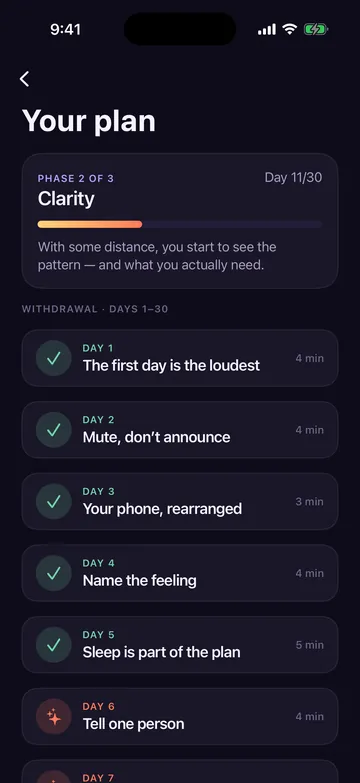
Zero Contact puts these seven habits in one place: a streak, SOS for urges, a reasons vault, a journal, a private coach and a 90-day plan.

Sources
- Fisher, H. E., Brown, L. L., Aron, A., Strong, G., & Mashek, D. (2010). Reward, addiction, and emotion regulation systems associated with rejection in love. Journal of Neurophysiology, 104(1), 51–60. doi.org/10.1152/jn.00784.2009
- Marshall, T. C. (2012). Facebook surveillance of former romantic partners: Associations with postbreakup recovery and personal growth. Cyberpsychology, Behavior, and Social Networking, 15(10), 521–526. doi.org/10.1089/cyber.2012.0125
- Langeslag, S. J. E., & Sanchez, M. E. (2018). Down-regulation of love feelings after a romantic break-up: Self-report and electrophysiological data. Journal of Experimental Psychology: General, 147(5), 720–733. doi.org/10.1037/xge0000360
- Pennebaker, J. W. (1997). Writing about emotional experiences as a therapeutic process. Psychological Science, 8(3), 162–166. doi.org/10.1111/j.1467-9280.1997.tb00403.x
- Larson, G. M., & Sbarra, D. A. (2015). Participating in research on romantic breakups promotes emotional recovery via changes in self-concept clarity. Social Psychological and Personality Science, 6(4), 399–406. doi.org/10.1177/1948550614563085
- Bowen, S., & Marlatt, A. (2009). Surfing the urge: Brief mindfulness-based intervention for college student smokers. Psychology of Addictive Behaviors, 23(4), 666–671. doi.org/10.1037/a0017127
Zero Contact is a self-help tool, not therapy or medical care. If you are in danger or thinking about hurting yourself, contact your local emergency number or find a helpline at findahelpline.com.